In my latest post (Switching to kernel
2.6), I spoke quickly about my
firewall. In the comments, I was asked for information about it. So I
decided to write a new post.
My firewall is based on a micro-ATX PIII mainboard with an Intel Celeron
600. I know that it is too much for my use (the load is almost always
0), however I already had the mainboard. This processor is one of the
slowest processor that the mainboard accepts (the lowest speed is 500
MHz). Anyway that kind of processor is a good choice for such a
computer, as it is one of the first processor using a 0.18µm technology,
thus it doesn't need a lot of power (for an x86). Using an Aqua 690
heatsink it can run without a fan.
This mainboard has an integrated Ethernet adapter, and 3 PCI ports. I
chose to use them to plug three Ethernet adapters, that is to say a
total of four. Currently three of them are setup in bridge, but I can
later un-bridge one or more ports if I need. It could be useful to plug
a WiFi access point, or to create a DMZ for my servers (just for the fun
as I am the only user of my LAN).
Instead of using an hard-drive, that makes noise and heat, I chose to
use a 256MB Compact Flash instead. I made a CF/IDE adapter using the
article published in Elektor
(April 2002 for the French edition). It is now possible to find such an
adapter in some webshops.
I packed all that stuff in a metal box, with a 120W Shuttle Power
Supply. The longest part was to machine the metal, with a drilling
machine and a file in my case.
On the software side, this firewall is running Debian, with two scripts
of my own using iptables: one for IPv4 and one for IPv6. 256 MB is
enough for that and some useful packages (ADSL modem drivers, radvd,
ping, traceroute, tcpdump, ethstatus, lm-sensors, snmpd, ntp, logcheck,
etc.).
Below is a photo of the inside (sorry for the poor quality, I took it
with my webcam as I still don't have a digital still camera):
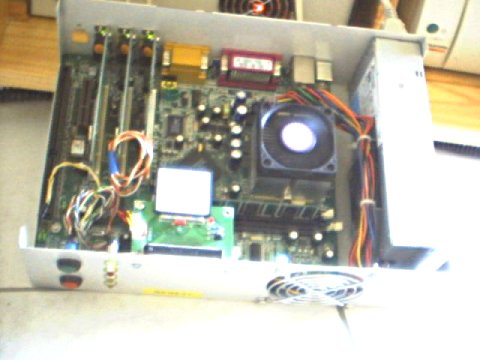
You can see a fan grille on the front, however there is no fan behind
it. I removed it as it was making noise, and was not really necessary.
Concerning the processor's fan, I control it using lm-sensors, and it is
almost always off, resulting in a very silent firewall.
I used the same box for my servers, however they are using an
hard-drive. It is possible to put up to two hard-drives (useful for
RAID1) in a such box, if you are using low profile RAM.